
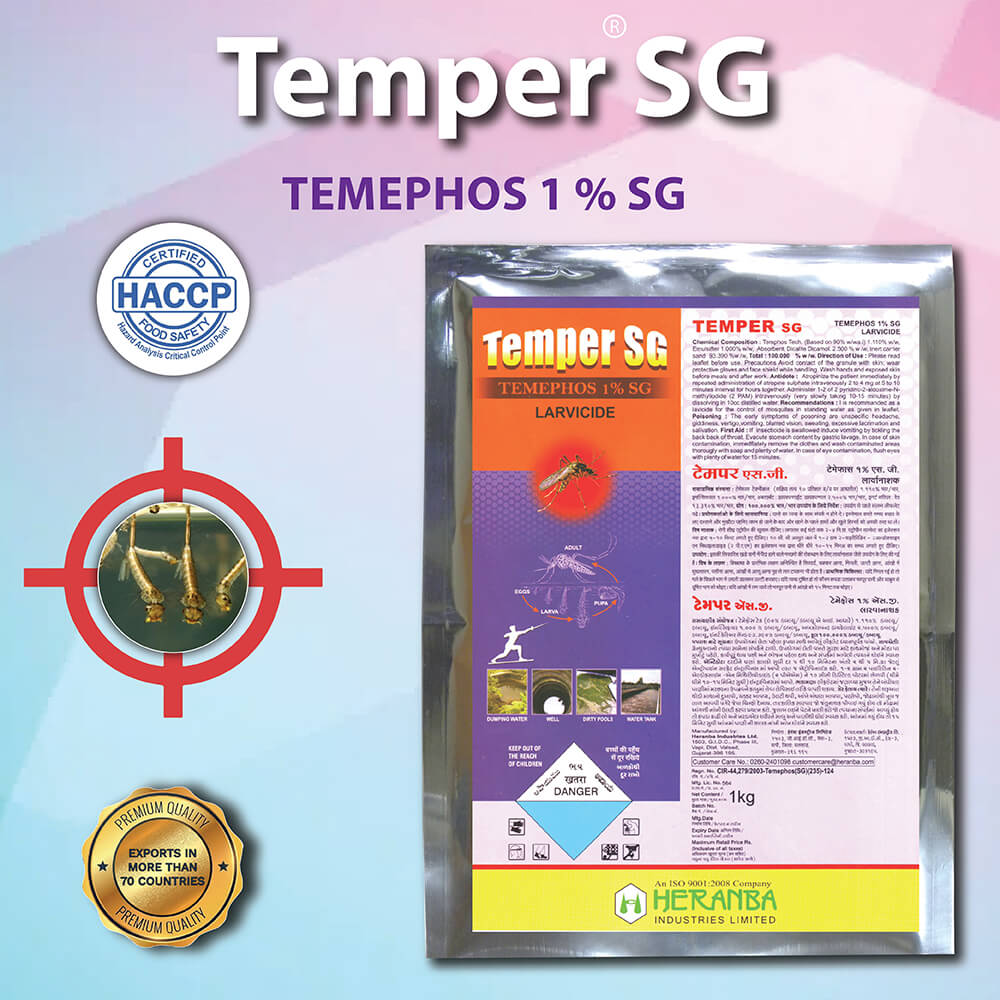
TEMPER SG
Brand Name: TEMPER SG
TEMPER SG is a granular larvicide formulated with Temephos 1% SG for professional mosquito larvae control. It is certified with HACCP and WHO and acts as a contact poison, spreading efficiently in water bodies and remaining effective for up to one week after application.
Key Features & Advantages
- Active Ingredient: Temephos 1% SG
- Certified with HACCP
- Certified with WHO
- Granular formulation for easy application
- Contact poison mode of action
- Spreads uniformly in water bodies
- Effective for one week after application
- Professional public health larvicide
- Highly reliable mosquito larvae control
Technical Specifications
| Product Name | TEMPER SG |
|---|---|
| Brand | TEMPER SG |
| Active Ingredient | Temephos 1% SG |
| Category | Larvicide |
| Formulation | Soluble Granule (SG) |
| Mode of Action | Contact poison (Cholinesterase inhibitor) |
| Target | Mosquito larvae, fly maggots |
| Certifications | HACCP, WHO |
| Presentation | 1 Kg, 25 Kg, 40 Kg |
Dosage & Application
- Mosquito Larvae Control:
- Clear Surface Water: 100–200 gm per hectare (10 gm / 10 Ltr water)
- Polluted Surface Water: 200–400 gm per hectare (20 gm / 10 Ltr water)
- Sewage pits, soak pits, latrines, septic tanks: 4 gm per 1000 Ltr water
- Fly Maggots Control:
- 5 gm in 5 Ltr water to cover 10 sq.mt area
- Granular Field Application:
- Clean Water: 5 – 10 Kg / hectare
- Moderately Polluted Water: 10 – 20 Kg / hectare
- Highly Polluted Water: 20 – 50 Kg / hectare
Antidote Information
Atropinize the patient immediately and maintain full atropinization by repeated doses of 2 to 4 mg of atropine sulphate intravenously at 5 to 10 minutes intervals. As much as 25 to 50 mg of atropine may be required in a day. The need for further atropine administration is guided by continuance of symptoms. Dissolve 1–2 gm of 2 PAM in 10 ml distilled water and inject intravenously very slowly for 10–15 minutes.
Applications
- Public health mosquito control programs
- Municipal larviciding operations
- Drainage systems
- Stagnant water bodies
- Sewage and polluted water areas
- Septic tanks and soak pits
- Fly maggot control areas
- Urban and rural mosquito control projects
- Professional pest control operations